
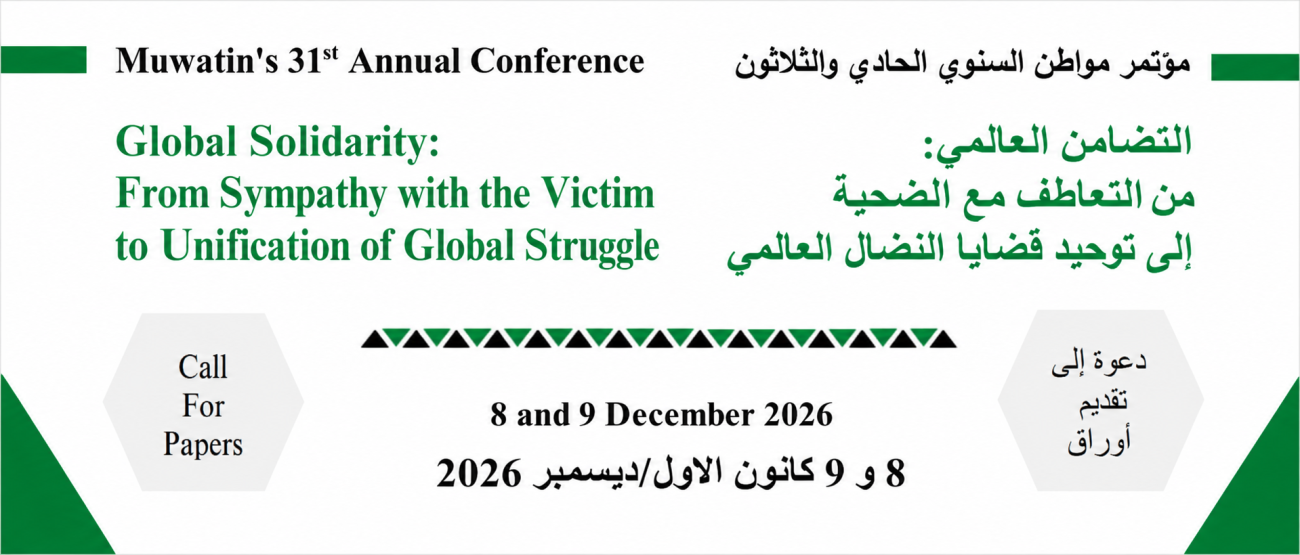
Muwatin’s 31st Annual Conference
“Solidarity: From Sympathy with the Victim to Unification of Global Struggle”
To be held on Tuesday and Wednesday, 15–16 December 2026
Muwatin’s 31st Annual Conference will interrogate solidarity from a range of perspectives, in attempt to answer the central questions: What lessons can we learn from the global solidarity movement with Palestine? What are the political possibilities and limits of this solidarity? To what extent can it serve as a model for a shared global struggle against systems of domination and colonialism? And what is the responsibility of Palestinians toward those who stand in solidarity with them?
Call for Papers
Muwatin’s 31st Annual Conference
“Solidarity: From Sympathy with the Victim to Unification of Global Struggle”
To be held on Tuesday and Wednesday, 15–16 December 2026
Over the past three years, during which Israel has waged a war of annihilation against the Palestinian people, the world has witnessed a broad global solidarity movement. This widespread mobilisation has revived debates around the concept of global solidarity, bringing it back to the heart of political, cultural, and academic discussions around the world, particularly in Palestine, whose cause has once again moved to the forefront of pressing global issues and assumed a prominent position within the international struggle against colonialism and domination. The solidarity movement has also raised renewed questions about solidarity itself: its forms, limits, means, manifestations, and the shared global political horizons it makes possible; the possibilities for organising and building on it; and the prospects of transforming it into a principal instrument of international struggle against global structures of domination and colonialism.
Despite the fact that the solidarity movement has failed to stop the attempted annihilation, which has been going on for over two years, the significance of solidarity extends beyond the question of whether it succeeded or failed in bringing the annihilation to an immediate halt. It reaches instead into a broader discussion of its future and prospects. The importance of solidarity lies in the way in which it connects the colonial project in Palestine, on the one hand, with global capitalist economic elites, on the other. It also lies in its role in exposing the dysfunction of liberal democratic systems, which have failed to respond to the demands of millions while submitting to the interests of powerful economic elites. Furthermore, solidarity movements with Palestine have succeeded in exposing and breaking some of the stereotypes and barriers that had become deep-rooted over the past eight decades. They have raised questions about official Western support for, and unlimited complicity with, Israel, as well as about the system and structure of global hegemony that is committing genocide in Palestine, as it wages wars around the world, suppresses demonstrations in numerous cities, and imposes impoverishment policies all over the world.
Although solidarity does, in part, take the form of limited or temporary moral acts grounded in sympathy with victims of oppression, aggression, genocide, and the like, what distinguishes it from sympathy, empathy, and similar responses is that it is an act based not only on emotions, but also on a shared interest and/or common goal. It opens new political horizons for building alliances among global forces opposed to domination and colonialism, and for devising tools of struggle that enable these forces to confront structures of domination, rather than merely expressing condemnation of the crimes committed, and providing symptomatic relief.
This conference seeks to interrogate the limits of the solidarity currently expressed with Palestine in all its forms, and to explore the possibilities of its development, transformation, and rejuvenation into a broad and globally widespread political instrument of emancipatory struggle. This discussion comes at a time when the neoliberal era, which emerged from global capitalism five decades ago, has entered the phase of decay. The social and economic crises it has caused have become too great to be contained through limited interventions using the very tools of the existing system. Under neoliberalism, class inequalities have widened into an enormous chasm; deprivation and poverty have spread globally; unemployment has increased; prices have risen; and food security has deteriorated. At the same time, wealth has become increasingly concentrated in the hands of a small minority that controls the economy.
Amid this crisis of the neoliberal system, the world is witnessing the labour pains of the birth of a new global order whose contours and features are difficult to predict. Yet it is easy to see the struggle among the various forces of domination over its nature, form, and the positions they will occupy within it. In this struggle, violence, fascism, and populism have come to be almost as naturalised. These are precisely the conditions that made the annihilation attempt in Palestine possible, under the complicity of same powers that have long proclaimed their commitment to democracy and human rights.
Against the backdrop of these transformations and global crises, and the early signs of an emerging world order, Palestine has become a space in which the defining features of global capitalism intersect: class exploitation, colonialism, racism, and domination in their neocolonial and neoliberal manifestations. These forces disregard human rights and international law, as well as gender equality, and gender justice, climate justice, freedom of expression, citizenship, and social justice generally. This makes solidarity with Palestine, and emancipatory solidarity more broadly, a matter that extends beyond temporary solidarity with a victim subjected to direct material annihilation. It becomes a protest against the global condition as a whole, of which colonialism in Palestine is a stark manifestation. While the genocide waged by Israel against the Palestinian people constituted the spark that ignited broad global solidarity after decades of dormancy, a dormancy that neoliberal policies had succeeded in normalising, the build-up of global social and economic crises constituted a factor driving those harmed by the global neoliberal order toward solidarity. The genocide, therefore, is not in itself the decisive factor behind the revival of global solidarity; rather, it was the spark that stirred already smouldering ashes.
This analysis leads us to assume that solidarity with Palestine, as a scope of protest expression against the global condition as a whole, and against the crises generated by forces of domination, calls for a fundamental rethinking of solidarity itself, not as an emotional concept, but as a mechanism with a political horizon available to forces opposed to domination and colonialism. The nature, limits, and future of existing global solidarity must therefore be understood in light of current global geopolitical transformations.
Since the struggle against the global system of domination and its various manifestations cannot be waged by any one party or people alone, the decisive factor determining success or failure in defeating this system lies in the ability to bring together and organise forces opposed to global domination and colonialism, coordinate their actions, and engage in this long and arduous struggle. It also lies in the ability to crystallise the forces that share an interest in ending the system of domination as a whole, rather than merely improving their position within it. In the context of solidarity with Palestine, the measure of success lies in developing forms of collective action that enable the masses protesting against rising prices, unemployment, poverty, and war, and in support of Palestine, to assert themselves as an counter-force confronting those who monopolise decision-making within the structures, and constituent elements, of the current global order, whether states, monopolies, or organisations.
Within the Palestinian context, Palestine’s position on the map of the global struggle against domination and colonialism—as a frontline where the forces of colonialism, imperialism, and global domination, acting through their Israeli proxy, confront forces of liberation and struggle against them—requires the reorganisation of the Palestinian domestic political landscape. It requires rethinking the national project, its tools of struggle, alliances, and objectives in ways that correspond to the global position occupied by the Palestinian cause and to Palestine’s centrality within the struggle against global forces of domination. This must also ensure the ability to harness and elevate the role of the intersections between the growing global struggle against capitalism and various forces of domination, and the Palestinian struggle against colonialism as one manifestation of the global system of domination, in pursuit of the Palestinian national project of liberation and the dismantling of the colonial system.
At another level, the global solidarity movement poses a range of questions concerning the future and prospects of human rights, and the future of the democratic system, as well as the transformations that may affect both in the context of global solidarity. This is particularly significant given the growing indications of the failure of the existing liberal order to safeguard human dignity, especially in realising social and economic rights and protecting people from the unchecked power of corporations and market forces, as well as from poverty and deprivation. The global order’s growing departure from law, rights, and democracy, and its immanent transformation towards oligarchy and ultimately fascism, raises the question of how the future should be constituted; a question that has confronted masses of protesters against the current global condition in its diverse local manifestations.
Rubrics
Muwatin’s 31st Annual Conference will interrogate solidarity from a range of perspectives, in attempt to answer the central questions: What lessons can we learn from the global solidarity movement with Palestine? What are the political possibilities and limits of this solidarity? To what extent can it serve as a model for a shared global struggle against systems of domination and colonialism? And what is the responsibility of Palestinians toward those who stand in solidarity with them? The conference will address these questions through the following five main themes.
First Rubric: The Concept of Solidarity and Its Transformations
This rubric seeks to shed light on the concept of solidarity more broadly, the transformations it has undergone over the past three years, and how the concept can be understood theoretically today. It will examine the principal factors and actors reshaping the concept, its emerging trajectories and meanings, the distinction between sympathy, support, and solidarity, and the political dimensions of the concept, among other aspects that seek to deconstruct solidarity itself and reconsider it in light of the current solidarity movement.
Second Rubric: The Solidarity Movement with Palestine: Momentary Sympathy with the Victim or Protest against the Global Condition?
This rubric looks into the nature of the global solidarity movement with Palestine today. It seeks to address how the widespread solidarity with Palestine around the world should be understood, and to consider its limits and trajectories. Is it a momentary movement tied to the genocide and sympathy with its victims, or has it provided a means through which people around the world have expressed their protest against a deeply troubling global condition, burdened by the economic, social, political, military, and livelihood crises caused by neoliberalism? To what extent does mobilisation for Palestine intersect with concerns about the endangered future of other peoples?
Third Rubric: The Political Prospects for the Global Solidarity Movement
This rubric examines the political prospects of the global solidarity movement with Palestine and the possibilities for transforming it into an organised global movement of struggle against domination, fascism, and populism; dismantling structures of colonialism, exploitation, and monopoly; pursuing social justice; and the protection human rights and dignity. It will also address the organisational, political, and institutional conditions necessary for transforming the global solidarity movement into a sustainable and organised international movement.
Fourth Rubric: The Palestinian Domestic Condition and the Obstacles it Poses to a Shared Global Struggle
This rubric examines the Palestinian domestic situation and the ways in which the current Palestinian elites understand solidarity with Palestine. It considers the constraints and obstacles created by the crises of the Palestinian political system and the absence of a national project, and how these prevent Palestinians from building upon the broad solidarity movement and consolidating its achievements. It also considers the prospects for building alliances with progressive forces around the world around a shared vision and struggle that places Palestine at the heart of the global struggle against domination, capitalism, and colonialism, while reviving Palestinian solidarity with other peoples around the world fighting for social justice, freedom, and human dignity.
Fifth Rubric: The Reception of Human Rights within the Solidarity Movement
This rubric inspects the future of human rights in the context of activating transnational solidarity as a mechanism, and the possibilities for building upon the current solidarity movement to develop the human rights system and transform it into an emancipatory instrument aimed at liberating human beings and safeguarding human dignity. It will also discuss the role of the forces active within the global solidarity movement in influencing the human rights movement, its structures, instruments, and institutions, and what is required to reform them and transform them into emancipatory tools in light of the current solidarity movement.
Paper Submission
Abstracts of papers or interventions, up to 250 words, should be sent to Muwatin@birzeit.edu no later than 15 October 2026, and should relate to one of the rubrics or topics listed above. The time allotted for presentations will be 20 minutes. Papers will be selected based on the abstracts submitted Selection will take into account the diversity of topics and the possibility of distribution to different sessions as a basis for selection.
